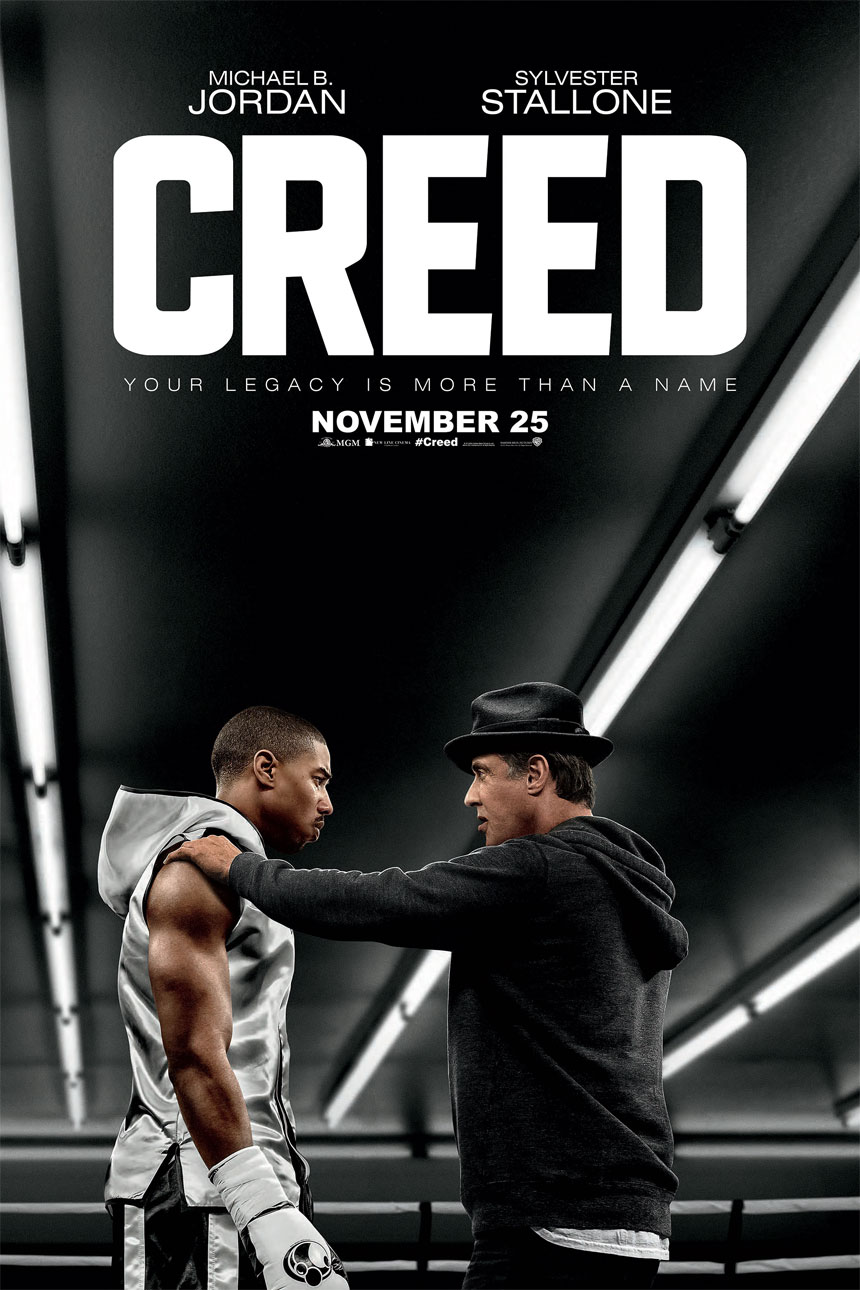
Ryan Coogler's Creed takes on the task of shifting an iconic American franchise into the 21st century. The film touches on the typical subject matter of a boxing film, issues of class, poverty and wealth, struggle and success. But the films own legacy lends it the unique opportunity to present a story about aging, a passing of the torch, as well as a tonal shift from competition and conquest, to shared success.
Centering on the training of Adonis Creed by Rocky Balboa, the film carries a message about identity. A key part of the movie revolves around whether or not Adonis should use his father's name during his fights, and whether or not the name, and the legacy that comes with it, belongs to him.Throughout the film, it is Adonis himself, and his fixation with his father's legacy, that holds him back the most. This is addressed briefly in the film, when Rocky has him "shadowbox" with his own reflection. The film reflects on the impact of identity on success, with perception, both self and public, having central role in the film. Ultimately, Adonis reaffirms his identity as a Creed, while forging his own legacy, as Rocky passes on to him his own.
As far as boxing films go, Adonis' character was refreshingly different. Unlike his famous predecessors, Adonis does not box out of necessity, but for more personal reasons. Adonis, before his boxing careers begins, had the strange circumstance of having a troubled early childhood, only to grow into a life of luxury and success. Adonis' early struggles, and later lifestyle are also attributable to his father's boxing career as well. His unique upbringing creates an incentive in Adonis to come to terms with, and learn more about, the man responsible for his challenges, and his later success. Adonis does this by taking up his fathers legacy of boxing, whilst simultaneously creating his own.
The theme of struggle and hard work runs deep through the boxing genre, particularly in the Rocky franchise and it's famous training montages. While boxing is often portrayed as foolish within the genre, a savage, primitive sport that somehow flew under the radar and made it into our modern world. Out of place and anachronistic. Yet, within sports in general and boxing in particular there is a particular appeal, that's almost subconscious. An appeal to an inner desire to prove one's worth, to emphatically announce to the world, as Creed puts it that: "I'm not a mistake". In Adonis' case, there was a sense of unfulfillment looming over his life. There is something about success unearned that feels wrong, incomplete. Adonis takes up boxing in this context not only to come to terms with the legacy of his father, but to prove himself worthy of it.
The final shot of the film takes inspiration from the famous stair scene from the original Rocky, but shifts the tone of the scene. Rather than the victorious, competitive vibe coming from it in the Rocky films, Creed blends nostalgia with pride to create a moment, that closes an open wound left in the Rocky franchise. A product of the racial tension in the mid-late 20th century, Creed shifts the narrative into the 21st century by ending the film with a peaceful, optimistic, almost reconciliatory tone. The film comes to terms with it's past much like Adonis does, seizes the present, and looks forward to a brighter future.
John G. Avilsden's Rocky is an iconic boxing film. An American classic. While they didn't reinvent the wheel when it comes to the typical boxer's story, Rocky still manages to contribute to the conversation that the boxing genre has opened.
The typical tale of a washed up underdog, Rocky follows the overarching narrative of a working class boxer, punching his way to success. He fits the mold cast by his predecessors. Where and why the film breaks this mold is where we can dig into the core of the film, and understand what sets it apart from other boxing films.
Context is crucial to understanding Rocky. Set during, and released during, the American Bicentennial, as well as the cold war, Rocky had a lot of pressure to be an All-American hero. Indeed, this aspect of Rocky is further explored in the sequels of the film, with the introduction of a Soviet boxer. It's no surprise then, that red, white and blue are a recurring motif throughout the film. Posters, shorts, lights, everything is red, white, and blue. The theme of American celebration runs strong through Rocky, but looking past the flashy, arranged event that is the main fight between Rocky and Apollo, we see a different side of America. We see the run down, but lively neighborhood's Rocky and friends live in, the store's they frequent, the gym's they train in. We see the inside of America's industrial backbone in the meat plant, and the luxurious home of Rocky Balboa. We are given a peak into a life that is peaceful and content, but often repetitive and slightly depressing. Rocky exposes the cracks in a society that was promised greatness, and delivered mediocrity.
You had the talent to become a good fighter, but instead of that, you
become a leg-breaker to some cheap, second rate loan shark!
Rocky begins the film as the enforcer for a local loan shark. This unsavory occupation becomes a focal point for many of the films important conflicts. While being a "leg-breaker" is not usually considered an honorable profession, the film does not seem to be criticizing Rocky for his life choices, in fact it portrays Rocky as a sort of "righteous" debt-collector, who refuses to carry out needlessly cruel requests like breaking fingers and bones, or accept a victims clothes as compensation. Instead, when taken as a whole, the whole loan shark operation serves as a red flag for greater societal issues. A certain amount of poverty and desperation has to exist in a population before they start to turn to loan sharks for financial services. The overall sentiment of the film is expressed in the quote included above from Rocky's would-be trainer. Disappointment. He's not the only one who is disappointed, throughout the film, Rocky's friend Paulie constantly asks for help getting a job with the loan shark. Disillusioned with his job, his life, Paulie is willing to turn to less than legal means to achieve his goals. In the world of Rocky Balboa, the American Dream is not dead, but people are starting to get impatient.
"I can't haul meat no more"
This is perfectly exemplified in Paulie's confrontation with Rocky and Adrian. In his rage he rants about his frustration, with his job, with his family, with his marriage outlook. In this way, Paulie and Rocky are very similar characters, they both start the film "getting by", with Rocky responding to a criticism of his career by saying "it's a living". The film seems to be challenging Americans, like a mirror, it is reflected on us and shows us exactly what getting by and being complacent looks like.
"He doesn't know it's a damn show! He thinks it's a damn fight!"
That, is where Apollo Creed comes in. A man of spectacle, the spitting image of Muhammad Ali. Apollo is depicted as flashy, a showman. Creed's role is two-fold, to serve both as an inspiration, and exciter, and also as a criticism of blind optimism and hubris. Creed reminds us of what America was supposed to be about, "do you believe America is the land of opportunity?". Creed is the American Dream incarnate, offering a shot at the world championship to some bum from Philadelphia. He reinvigorates the public, reminds to aim higher, to not be content. But Creed's optimism is two-sided. American to the point of satire, Creed can be seen as a criticism of the glorification of America on it's bicentennial, when we have previously observed the levels of poverty and mediocrity still present in the supposed "land of opportunity". Furthermore, Creed's optimism gets the better of him in the end.
Through Rocky, we see a third option. He rejects the complacency and laziness of Paulie(who undergoes a change in the end), and also the hubris of Apollo. Rocky reaffirms the American faith in hard work, and determination, epically summarized in a legendary montage. Rocky's goal isn't to win, but to prove to himself, and his family and community, that he can go the distance. That he's not "just another bum from the neighborhood". That in America, a nobody can be somebody, if they put in work. Do you believe America is the land of opportunity?
Micheal Mann's Ali, while exploring the same subject as When We Were Kings, tells a very different story. Both tell the story of Muhammad Ali, but where When We Were Kings focuses on the "Rumble in the Jungle" and Ali's personal political and cultural influence, Ali, unshackled by the limits of a documentary format, explores the effects of political and cultural events on Ali himself. The film explores Ali as a character, with flaws and vices. The documentary is limited to existing footage of Ali and interviews, Ali can take advantage of the use of actors to take the audience into Ali's most personal moments, it can take us inside the ring, into cars and locker rooms.Through a fictional Ali, we can explore the real one.
Having seen documentary footage of the real Ali, it is easy to spot where the film departs from reality. Characters are moved around and lines are modified.The creative liberties the filmmakers took with the film may deviate from the reality, but they allow the film to better illustrate to the audience exactly who Ali was.The use of fictional footage, while less real than actual footage, is much more personal.Emphasis on the dramatic, impossible camera angles, the film brings the
audience into the heart of the action. This allows the film to explore
the less public side of it's characters. Rather than the bombastic, charismatic Ali we are presented with in When We Were Kings, we see a more reserved version. His flaws and vices, hidden from the world, are exposed to the camera, as we peek into his personal life of infidelity.
Ali's relationship with Malcolm X, and the civil rights movements as a whole, is a very important aspect of Ali's story that is able to be explored within the format of the film. Intimate phone calls between Ali, Malcolm, and the nation are depicted, the assassination of Malcolm, and it's effect on Ali is able to be brutally depicted. Tension within the nation of Islam are exposed, as we see the interactions between the faction and Ali and Malcolm. Important scenes, including one where Ali remarks "I never stopped being a Muslim" and "I love the nation, but it does not own me"provide important insight into the organization of the civil rights movement. A complex, multi-faceted issue, Ali stands out from the Nation of Islam, both for his behavior, and his approach towards the faith. Where the Nation is dogmatic, impersonal, and unforgiving, Ali is flexible, passionate, and capable of giving second chances. Although they all share the same goal, their approach is very different.
The civil rights movement is as much a part of Ali's history as Ali is a part of it's history. The two are intertwined. How else could someone have risen as high as Ali, without the anger of 400 years of imprisonment and enslavement. How else could they have challenged the federal government, in wartime? Similarly, the civil rights movement undoubtedly benefited from the influence of young and passionate heroes like Ali, who were not afraid to stand against the tide for what they believed. In the first 10 minutes of the film, the audience is introduced to the frustration of community, where we see Ali tailed by the cops during his late night training session. We see a younger Ali attend a speech being given by Malcolm X, a first encounter captured before the significance of both of these characters is fully revealed. The scope of the film only really encompasses the later stage of the relationship between these two, but the use of montage allows the audience to get a basic understanding of the relationship between these tow characters.
Ultimately however, the key focus of the film is that of identity. The level of importance Ali places on his name being correctly used reflects the attitude of an individual, and a culture that has been oppressed and mistreated for too long. The importance of correctly identifying Ali stems from the fact that in this era of conflict and hope, every success and every triumph is important. From Ali's father getting indignant about his son's name change, to the "x's z's and y's" of the nation's members, the film explores Ali's story in a time of cultural crisis, and a demand for recognition, of a people's true identity.
A common thread tying together many boxing films is an exploration of a boxer's relationships outside of the world of boxing. These relationships act as a window into the personality of a boxer, giving us a glimpse into who they really are. Deteriorating and weak relationships are also a symptom of a morally flawed person, or a corrupting influence. Gender relationships in particular are often in the spotlight, with films depicting and challenging typical gender dynamics through the hyper-masculine lens of the boxing world, and in later films, flipping the whole dynamic on it's head with the introduction of female boxers.
Taking a look at 4 noteworthy boxing films from different eras,we can see different depictions of these relationships, and notice a general shift in perception over the decades. Specifically, we will be looking at Champion, and it's womanizing scoundrel of a lead Midge Kelly. Raging Bull, and the physically and mentally abusive Jake La Motta. Girlfight, and it's empowering shake up of traditional gender dynamics as Diana Guzman takes up boxing. And Million Dollar Baby, with it's alternate take on gender through the lens of a pseudo-father-daughter relationship. These four broadly capture the discourse on gender that boxing films have been exploring for decades.
Starting chronologically with Champion, the iconic scene above dramatically sums up Midge's interactions with women throughout the film. Charming, yet sinister, calm, yet violent. Nonchalantly discussing his affair with a married woman with his own past mistress, while also mentioning his current marriage, and then capping it off with a threat of violence. If there was ever any doubt that he was not a nice person, this scene does away with it all. Midge as a character represents a sort of critique through example of the corrupting influence of money and fame. A corrupted person is not a completely changed person, and those corrupting influences act as more of a magnifier of existing attitudes than as a brainwash. The violent, casual attitudes that Midge displays in that scene existed within him long before he first entered a boxing ring. Leonard Berkowitz found in his study on "The effects of observing violence" that observing violence, while sometimes having a cathartic effect, can in fact increase the observers likelihood to engage in violent behavior. While exactly an "observer", Midge Kelly was present for all of his fights(duh). Not only that, but Midge's role in the fight makes him particularly suggestible to violence per the studies observation that:
"an angered person who saw what appeared to be warranted aggression might well think he was justified in expressing his own hostile desires"
Midge, competing in a sport that glorifies and justifies violence, would be very likely to develop attitudes that would cause him to carry over his violence outside the ring. His violence is not sadistic, it is not manipulative, he uses violence to take what he wants. He dominates his environment whether he is inside or outside the ring. Near the end of the film, Midge rapes Emma, to show that he can. His hyper-masculine, hyper-competitive attitudes lead him to success in the ring, but at the cost of the destruction of all his relationships, and eventually his life.
Moving on to Raging Bull, Jake La Motta in this memorable scene from the film is all but literally burning down the bridges of his relationships. Climaxing a dreadful increase in paranoia and manipulative behavior throughout the film, in this scene the dirty laundry is hung out to dry. Scorsese's film offers the audience a view into the warped, out-of-place mind of an ultra-successful, ultra-destructive boxer. The film examines La Motta as a fish out of water of sorts. A mindset that was once necessary, but is now out of place in society, only able to wrestle success out of the remnants of a more primal world, in the sport of boxing. Gerald Early in his essay "The Romance of Toughness", describes boxing as: "industrial culture confronting itself in fits of masculine nihilism". In a primal sport, a primal mindset will dominate, translating back into a industrial culture is another matter.
It is this mindset that drive La Motta's conflict with his wife and family. La Motta resembles a wild animal, a caveman having dragged a woman into his cave. Constantly on the lookout for treachery, competitors, and wolves, his paranoia weakens the foundations of his relationships. Vickie, his wife, is under constant surveillance, by both La Motta's. Greetings, conversations, drinks are questioned in interrogative fashion. Scorsese has La Motta grow jealous after his wife compliments the looks of an up-and-coming boxer, a direct competitor to La Motta, a perfect example of the toxic effect of his mindset. Soon simple greetings are met with sharp confrontation from La Motta, and he goes so far as to turn on his brother and attack him. Jake, similarly to Midge, develops a hyper-masculine personality, fueled by his boxing success, that eventually leads to the destruction of his family, and of himself.
Girlfight, similar to previous films, examines the place masculinity has in a boxing film. Unlike the previous two films however, it uses masculinity as an empowering, expectations defying characteristic of it's female protagonist. The first two films had to contend with the primal nature of boxing as a sport, and it's place in a civilized society. In Girlfight, boxing and the artificial obstacles Guzman faces in her pursuit of the sport represent the obstacles women face entering into male-dominated pursuits. Masculinity then, is not the characteristic of a flawed, malfunctioning human punching bag. It reflects a shift in attitude, a shift in perception. Short-hair, aggressive poses and facial expressions are no longer a male characteristic, they are the characteristics of power, of ambition.
No longer damsels in distress, or playthings left at home, Katharina Lindner writes in her essay "Fighting for Subjectivity" about a "shift towards a more realist representation of the active female body and its materiality and physicality", that Girlfight is a part of. She goes on to mention, that Boxing, while an empowering demonstration of physicality, and self-ownership is a powerful physical metaphor for the struggle for equality, is also implicitly masculine. This implicit masculinity,results in the exclusion of participants from the definition of femininity. We see this in the film through the mocking and exile Guzman faces during her training by her female friends. Caught in the middle, rejected by the female "world" and climbing uphill into the male "world" of boxing. Guzman's struggle is capstoned by a bout with her male partner, which eventually earns her and her gender the respect and inclusion she sought.
Shifting our examination over to Clint Eastwood's Million Dollar Baby, a vastly different film than the previous three, the above clip nicely captures the dynamic between the two lead characters. The gender dynamics are still there, but this time more of a father-daughter relationship than a relationship between romantic partners. This film focuses less on the masculinity/femininity of it's characters than the previous films. Instead the focus is on the relationships themselves. Both characters have missing relationships with their respective fathers/daughter, and both characters seemingly surrogate each other for that role. Throughout the film we can observe the role gender plays even on this relationship. Frankie's protective attitude towards Maggie, and her loyalty to him are perfect examples of where the relationship extends beyond a typical client-customer relationship, which we got an example of through Frankie's original fighter, as well as through Eddie, Frankie's even older previous fighter. The audience watches as the ties between Frankie and Maggie grow, as we
watch her succeed and climb through the ranks, only to come crashing
down at the end.
Frankie is emotionally devastated by Maggie's accident, as well as the request she makes of him. Euthanasia, being illegal, and intensely controversial, was a request only able to be made of someone with the closest of bonds. The shroud he gives her, with the Gaelic phrase "mo cuishle" aptly sums up the relationship, simultaneously making it possible, and extremely difficult, for Frankie to carry out Maggie's request to die.
Gender is an complex topic within the boxing genre, as every film is different, and approaches the subject in a different manner. The overarching thread however, appears to be an examination of the masculinity associated with the sport, and its effect on the participants and their relationships outside the ring.
Leon Gast's When We Were Kings is a documentary about the fight between Muhammad Ali and George Foreman in Zaire. The documentary format is a departure from the typical boxing film, and shakes up the archetypal boxers story. In addition to the changes in format and structure of the film, having a black protagonist shifts the perspective of the film, much like how Girlfight and Million Dollar Baby did with female boxers.
The film was mainly composed of actual footage of Ali, from press conferences to training sessions to TV recordings, with only a small number of interview shots of relevant people included in. The beginning of the film had a very striking montage integrated into the credits sequence. The documentary style changes the tone of the film, it makes into a retrospective, historical. The use of real footage conveys to the audience that what they are watching is so significant, that no reproduction was necessary, it was all caught on film as it happened. Spike Lee, a famous director, is included in the film as an interviewee, discussing the film and mentions that the current African American youth are often not very knowledgeable about their history and their culture. The film acts then, as a crash course in African American culture, featuring famous musicians, actors, directors, and more, with Muhammad Ali as the centerpiece.
Ali, and his interactions with the world, whether it's the boxing world or his African fans, or his rival, are what this film revolves around. He is constantly featured speaking at length about his technique and his strategy and his training, about the weakness of his enemy and how he will defeat him. Ali's attitudes do not defy the expectations we may have of him as a boxer, who are known to be brash, confident individuals. However, when you consider the time period, Ali's brash, confident, no-shit-taking attitude was inspiring to the African and African-American communities. Here was a man, who wasn't afraid to succeed, who wasn't afraid to go toe-to-toe with society, with Uncle Sam, over what he thought was right. That is the Ali that comes out in the film.
A celebration of their culture, When We Were Kings refuses to conform to accepted norms, refuses to silence loud voices, refuses to censor uncommon behavior. The film is not about Muhammad Ali, he says it himself, he is a tool for "god's work". The film seeks to educate it's audience, not about the situation they're in, not about the pleasant future they might have, but rather about what they are, at their core. A people, with a thriving culture and an important, but oft forgotten history. A history with consequences that linger to this day, in the societal backbone of the United States. The film covers Ali's trip to Zaire, where he is immediately confronted with surprising realities. He encounters a society poorer than his own, but unburdened by systematic racial oppression, and opportunity. This is not to say that Zaire was never the victim of colonialism and all of the horrors that accompanied it, but rather that is was a surprise for Ali to see a world of black pilots and airlines and black business owners,etc. Throughout the film, the message is not that we are all the same, that things can be better, and this will all pass someday. The film aims to show that things are better, in someways elsewhere, and that equality is not the same as sameness. There are important differences between cultures that Ali highlights in one of his speeches, but that rather than being ignored, or suppressed, that these differences should be exposed, celebrated, and respected. That passivity will not bring about better times, only confidence, drive, and self respect can accomplish that. The film educates a generation that might never have known about Ali and what he stood for, using only his actions, and his words.
Clint Eastwood's Million Dollar Baby also stars a female boxer, but this film has a very different take on both the archetypal boxer's story, and the female boxer's story. Where Girlfight is an empowering, challenging story of a female boxer defying the expectations placed on her individually and on her gender, Million Dollar Baby is an emotional, exploration into human relationships and class struggles.
Arguably the most important part of the film is the relationship between Frankie Dunn and Maggie Fitzgerald. Throughout the film, an initially reserved Frankie comes to become emotionally attached to Maggie, their relationship takes on a father-daughter vibe. Eastwood had to approach this relationship carefully, to be successful, the relationship had to be intimate, protective, but with ambition and pride. There is a fine line between a father-daughter relationship that is successful, and one that is paternalistic. In Girlfight, Guzman boxes to prove to herself, her family, and the world, that she is capable, that she's a "contender", that her gender doesn't define her abilities, and that she is worthy of respect. This stands in contrast with Million Dollar Baby and it's portrayal of the boxer's story. In an economic sense, the film returns to boxing's roots, Guzman is constantly reminded that boxing is not a profitable endeavour, but continue because she has something to prove. Maggie, on the other hand, has the typical boxer's economic motivation at the start of the film: a desperate attempt to escape poverty, to climb the social ladder in true American™fashion, and to take care of her family. Her emotional motivation departs from that of Guzman's in a significant way however, whereas Guzman was trying to earn respect, Maggie tries to earn Frankie's pride.
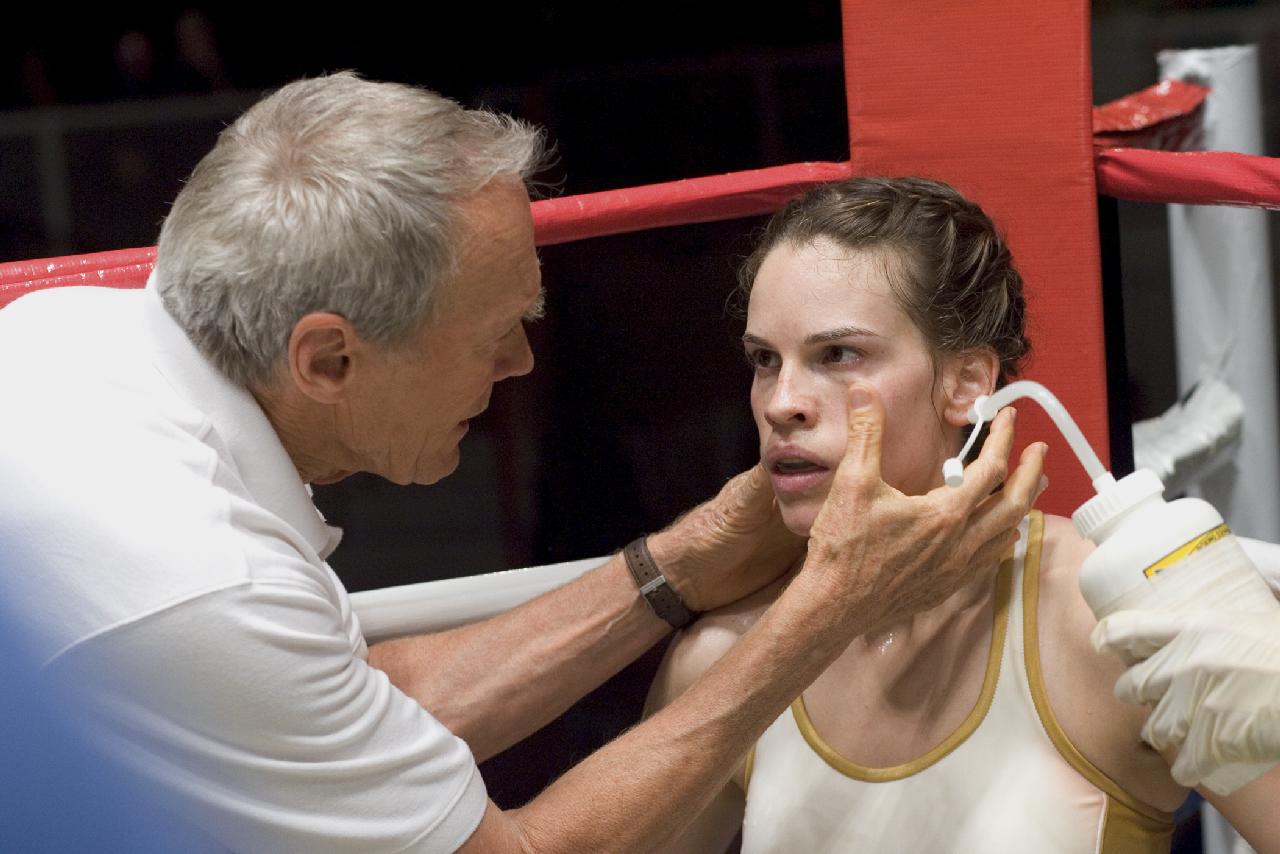
The father-daughter relationship between Maggie and Frankie is reinforced by the fact that both of them have damaged relationship with their respective father/daughter figures. It is revealed that Frankie's daughter has cut off contact with him, and that Maggie's father is dead. These revelations color the characters initial interactions as well, with Frankie's cold,reserved demeanor possibly stemming from emotional damage dealt by his daughter, and Maggie's eager, stubborn personality reminiscent of a child looking to a parent for approval. As the film progresses, it appears as if Frankie is living vicariously through Maggie. Eastwood makes good use of the corner scenes in the film here as the typical coach prep, advice, strategy, and first aid, is a great visual metaphor for a father fixing a scraped knee, prepping his child for the challenges they might face.
The ring in this film then, isn't the prison that it is in films like Body and Soul and The Set-Up, nor the cage it is in Raging Bull. In this film, the ring is the sidelines,separating the actors from the audience it represents the there, but not-there barrier separating a father from his child. Frankie cares about the success of Maggie, but he is forced to stand by the side and watch her sink of swim on her own. The film is narrated by Morgan Freem- I mean "Edie Dupris". The narration gives the film a retrospective tone, something that makes much more sense to the audience, as the film reaches out it's conclusion, and the films darker, tragic themes surface. It becomes clear that the narration is actually a message from Dupris to Frankie's daughter, presumably following his death. Eastwood's use of a narrator departs from the typical boxing movie we have seen. It allows the film to explore relationships not portrayed in the film, such as that of Frankie's daughter, or those in the future, such as Edie and Danger's future training and championship. Leaving Edie as the narrator allows Frankie to disappear after Maggie's death. "Mo cuishle" meaning "my heartbeat" suggests to us that after Maggie's death, Frankie's followed not long after.
Eastwood's inclusion of Euthanasia in the film is simultaneously heart-breaking, and ground-breaking. Many boxing films in the past have dealt with the physical destruction of the body that is risked in boxing, but none have done it quite so poignantly as Eastwood completely paralyzing his prizefighter in her moment of glory. The film establishes a sense of invincibility after Maggie crushes fighter after fighter in her "montage" to success. This illusion is shattered, by a rough-fighting boxer who's shove results in the end of Maggie's career. The destruction is two-fold, paralysis on it's own is no picnic, but, as Maggie puts it "I can't live like this, having seen what I seen, been where I been". Essentially, the high quality of life Maggie had come to known, made the tragic fall all the worse to bear. Unable to cope with the decay of her body in a hospital bed, she asks Frankie to help her die. Various discussions of fault and blame take place, as the characters attempt to cope with the situation they've been placed into, but eventually Frankie decides to do it. Maggie is released from her pain, and the characters are left to pick up the pieces.
Karyn Kusama's Girlfight changes and challenges the traditional boxing story by introducing a female protagonist in a typically male-dominated role. The film is able to simultaneously consider the female perspective in boxing, and boxing films. The fact that both of these settings are traditionally male-dominated allows for a unique spin on the boxing narrative, and it's typical entrenched interests.
Michelle Rodriguez was actually chosen for this role, despite a botched audition, because of her less "feminized" appearance, and the lack of "power" in the other 300+ auditionees.Guzman is definitely no pushover. She's aggressive, assertive,
dominant, kind of a lone wolf.As Katharina Lindner puts it in her essay on physicality in Girlfight: "She represents both a symbolic and a very real, physical and ‘lived’ transgression of normative notions of gender and bodily existence".
Guzman's relationship with her father captures the difference in expectations and opportunities made available to the two genders according to traditional mindset. He pays for boxing lessons for his son,
but not his daughter, instead he suggests she buy skirts, or makeup. She seemingly has to overcome a conflict with every character in the film in order to pursue boxing. This is in stark contrast to the typical boxer, who is usually encouraged by friends and family, at least in the beginning.
Another interesting deviation from the genre is in the perception of boxing as a sport. Whereas other films depict boxing as a sort of egalitarian, glorious Colosseum, where the risks and the rewards are high, Girlfight shifts this perspective. To Guzman, the boxing world is secluded, outdated, stuck in it ways and afraid of outsiders. She feels out of place, almost resented. Instead of being presented as the birthplace of champions, boxing is referred to as a "waste of time". It is frequently said that there are better things for Guzman to do, and that boxing is not a lucrative pursuit. A subtle metaphor for the trouble women have breaking into male-dominated fields, this shift also gives us an outsider's perspective on boxing. Much like a assertive, succesful businesswoman, "A skillful female boxer occupies an “emergent” position within the hegemonic ordering of society", as MacIntosh Ross puts it in his essay "Documenting the Female Boxing Experience".
Guzman has her reasons for wanting, but for many of the males boxer's in the film, it's "all they know". Distracted by all the fame and success of our previous boxers, it can be easy to fall under false pretenses that boxing is like any other career. By having a female, amateur boxer as our lead, that illusion is shattered.
Even without the promise of economic salvation through boxing, the conflict of market values vs family values reemerges in the film. Highlighted perfectly in the above scene where Guzman sells a family heirloom in order to continue to box. The conflict takes on a different tone, as it's less of a choice for Guzman to make, and more of an uphill battle. Neither the boxing world, nor her family are encouraging her to continue, and she must overcome both familial reservations, as well as economic realities to pursue her sport.
Taking a departure from the thematic elements of the film, Kusama uses these cardboard signs before important events in the ring throughout the film. They leave the audience with little tidbits of information to digest. Reminiscent of Raging Bull's fight cards, they serve as transitions into the action, while also adding a little bit of insight into the quality of the establishments in which Guzman is boxing, as well as the values of the people inside.
At it's most basic, Girlfight is a quest for respect. Guzman begins the film being looked down upon by her peers, her teachers, even her family. The endless discussions in the film about whether she is the same, or should/shouldn't compete with males is irrelevant to Guzman. She does not care whether or not she is the equal of the male boxer, in fact she realizes the differences and takes advantage of them. All that she wants is to be treated equally, and allowed the same opportunities as everyone else regardless of gender. Respect.