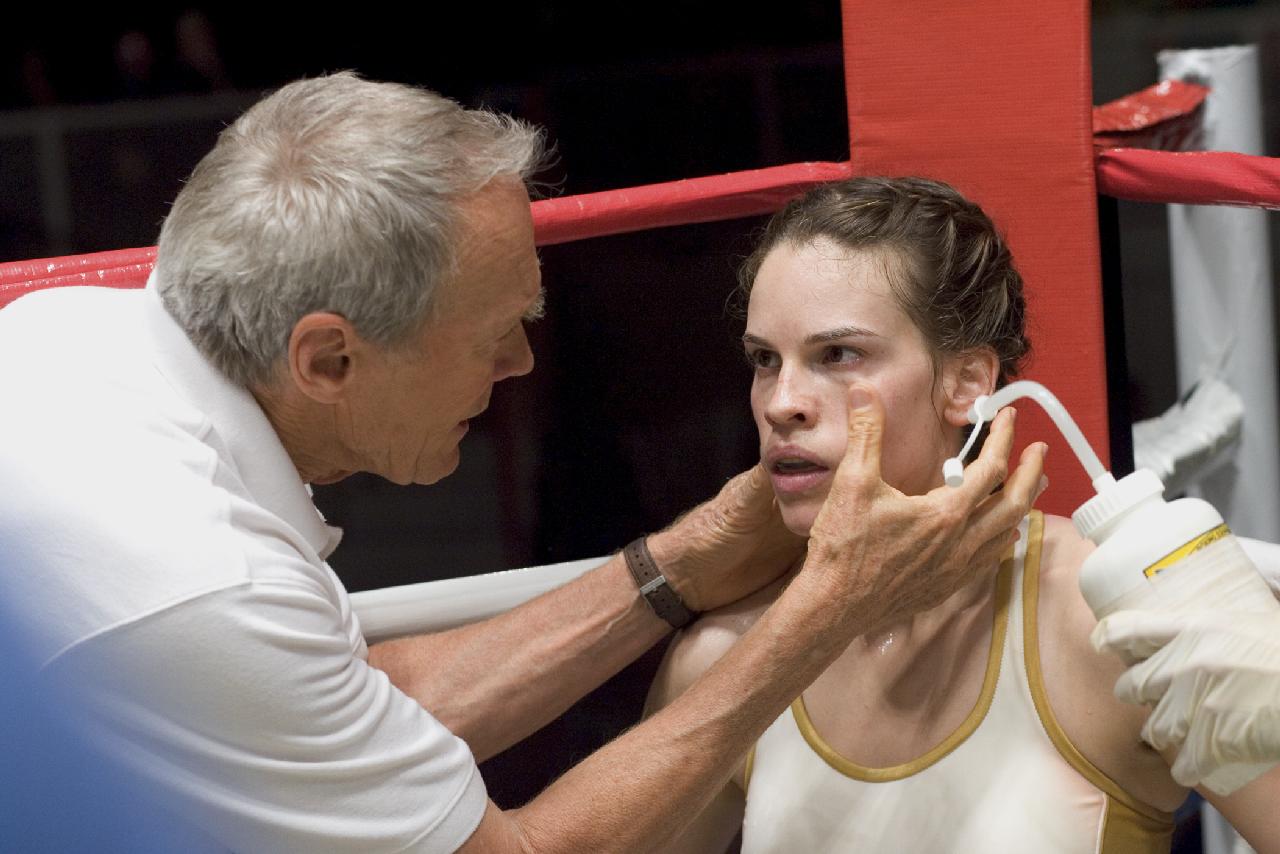
Clint Eastwood's Million Dollar Baby also stars a female boxer, but this film has a very different take on both the archetypal boxer's story, and the female boxer's story. Where Girlfight is an empowering, challenging story of a female boxer defying the expectations placed on her individually and on her gender, Million Dollar Baby is an emotional, exploration into human relationships and class struggles.
Arguably the most important part of the film is the relationship between Frankie Dunn and Maggie Fitzgerald. Throughout the film, an initially reserved Frankie comes to become emotionally attached to Maggie, their relationship takes on a father-daughter vibe. Eastwood had to approach this relationship carefully, to be successful, the relationship had to be intimate, protective, but with ambition and pride. There is a fine line between a father-daughter relationship that is successful, and one that is paternalistic. In Girlfight, Guzman boxes to prove to herself, her family, and the world, that she is capable, that she's a "contender", that her gender doesn't define her abilities, and that she is worthy of respect. This stands in contrast with Million Dollar Baby and it's portrayal of the boxer's story. In an economic sense, the film returns to boxing's roots, Guzman is constantly reminded that boxing is not a profitable endeavour, but continue because she has something to prove. Maggie, on the other hand, has the typical boxer's economic motivation at the start of the film: a desperate attempt to escape poverty, to climb the social ladder in true American™fashion, and to take care of her family. Her emotional motivation departs from that of Guzman's in a significant way however, whereas Guzman was trying to earn respect, Maggie tries to earn Frankie's pride.
The father-daughter relationship between Maggie and Frankie is reinforced by the fact that both of them have damaged relationship with their respective father/daughter figures. It is revealed that Frankie's daughter has cut off contact with him, and that Maggie's father is dead. These revelations color the characters initial interactions as well, with Frankie's cold,reserved demeanor possibly stemming from emotional damage dealt by his daughter, and Maggie's eager, stubborn personality reminiscent of a child looking to a parent for approval. As the film progresses, it appears as if Frankie is living vicariously through Maggie. Eastwood makes good use of the corner scenes in the film here as the typical coach prep, advice, strategy, and first aid, is a great visual metaphor for a father fixing a scraped knee, prepping his child for the challenges they might face.
The ring in this film then, isn't the prison that it is in films like Body and Soul and The Set-Up, nor the cage it is in Raging Bull. In this film, the ring is the sidelines,separating the actors from the audience it represents the there, but not-there barrier separating a father from his child. Frankie cares about the success of Maggie, but he is forced to stand by the side and watch her sink of swim on her own. The film is narrated by Morgan Freem- I mean "Edie Dupris". The narration gives the film a retrospective tone, something that makes much more sense to the audience, as the film reaches out it's conclusion, and the films darker, tragic themes surface. It becomes clear that the narration is actually a message from Dupris to Frankie's daughter, presumably following his death. Eastwood's use of a narrator departs from the typical boxing movie we have seen. It allows the film to explore relationships not portrayed in the film, such as that of Frankie's daughter, or those in the future, such as Edie and Danger's future training and championship. Leaving Edie as the narrator allows Frankie to disappear after Maggie's death. "Mo cuishle" meaning "my heartbeat" suggests to us that after Maggie's death, Frankie's followed not long after.
Eastwood's inclusion of Euthanasia in the film is simultaneously heart-breaking, and ground-breaking. Many boxing films in the past have dealt with the physical destruction of the body that is risked in boxing, but none have done it quite so poignantly as Eastwood completely paralyzing his prizefighter in her moment of glory. The film establishes a sense of invincibility after Maggie crushes fighter after fighter in her "montage" to success. This illusion is shattered, by a rough-fighting boxer who's shove results in the end of Maggie's career. The destruction is two-fold, paralysis on it's own is no picnic, but, as Maggie puts it "I can't live like this, having seen what I seen, been where I been". Essentially, the high quality of life Maggie had come to known, made the tragic fall all the worse to bear. Unable to cope with the decay of her body in a hospital bed, she asks Frankie to help her die. Various discussions of fault and blame take place, as the characters attempt to cope with the situation they've been placed into, but eventually Frankie decides to do it. Maggie is released from her pain, and the characters are left to pick up the pieces.
Karyn Kusama's Girlfight changes and challenges the traditional boxing story by introducing a female protagonist in a typically male-dominated role. The film is able to simultaneously consider the female perspective in boxing, and boxing films. The fact that both of these settings are traditionally male-dominated allows for a unique spin on the boxing narrative, and it's typical entrenched interests.
Michelle Rodriguez was actually chosen for this role, despite a botched audition, because of her less "feminized" appearance, and the lack of "power" in the other 300+ auditionees.Guzman is definitely no pushover. She's aggressive, assertive,
dominant, kind of a lone wolf.As Katharina Lindner puts it in her essay on physicality in Girlfight: "She represents both a symbolic and a very real, physical and ‘lived’ transgression of normative notions of gender and bodily existence".
Guzman's relationship with her father captures the difference in expectations and opportunities made available to the two genders according to traditional mindset. He pays for boxing lessons for his son,
but not his daughter, instead he suggests she buy skirts, or makeup. She seemingly has to overcome a conflict with every character in the film in order to pursue boxing. This is in stark contrast to the typical boxer, who is usually encouraged by friends and family, at least in the beginning.
Another interesting deviation from the genre is in the perception of boxing as a sport. Whereas other films depict boxing as a sort of egalitarian, glorious Colosseum, where the risks and the rewards are high, Girlfight shifts this perspective. To Guzman, the boxing world is secluded, outdated, stuck in it ways and afraid of outsiders. She feels out of place, almost resented. Instead of being presented as the birthplace of champions, boxing is referred to as a "waste of time". It is frequently said that there are better things for Guzman to do, and that boxing is not a lucrative pursuit. A subtle metaphor for the trouble women have breaking into male-dominated fields, this shift also gives us an outsider's perspective on boxing. Much like a assertive, succesful businesswoman, "A skillful female boxer occupies an “emergent” position within the hegemonic ordering of society", as MacIntosh Ross puts it in his essay "Documenting the Female Boxing Experience".
Guzman has her reasons for wanting, but for many of the males boxer's in the film, it's "all they know". Distracted by all the fame and success of our previous boxers, it can be easy to fall under false pretenses that boxing is like any other career. By having a female, amateur boxer as our lead, that illusion is shattered.
Even without the promise of economic salvation through boxing, the conflict of market values vs family values reemerges in the film. Highlighted perfectly in the above scene where Guzman sells a family heirloom in order to continue to box. The conflict takes on a different tone, as it's less of a choice for Guzman to make, and more of an uphill battle. Neither the boxing world, nor her family are encouraging her to continue, and she must overcome both familial reservations, as well as economic realities to pursue her sport.
Taking a departure from the thematic elements of the film, Kusama uses these cardboard signs before important events in the ring throughout the film. They leave the audience with little tidbits of information to digest. Reminiscent of Raging Bull's fight cards, they serve as transitions into the action, while also adding a little bit of insight into the quality of the establishments in which Guzman is boxing, as well as the values of the people inside.
At it's most basic, Girlfight is a quest for respect. Guzman begins the film being looked down upon by her peers, her teachers, even her family. The endless discussions in the film about whether she is the same, or should/shouldn't compete with males is irrelevant to Guzman. She does not care whether or not she is the equal of the male boxer, in fact she realizes the differences and takes advantage of them. All that she wants is to be treated equally, and allowed the same opportunities as everyone else regardless of gender. Respect.
We've now seen five boxing films since the start of this class, and the underlying narrative of the boxing film as a genre is starting to reveal itself. One of the threads of this narrative, running particularly strong in films such as The Set-Up, Body and Soul, and On the Waterfront, is the struggle of the working class to overcome the greed and corruption that accompanies wealth and success. Boxing films are almost by design perfect mediums for capturing a uniquely American experience.
The revolutionary social mobility that America is famous for translates perfectly into the boxers story. Charley Davis, a poor New Yorker is able to work his way to the top. Stoker Thompson dreams of winning a title shot and fighting his way to an easier life. Terry Malloy lives with a chip on his shoulder ever since the day he was forced to throw a fight that could have made him "a contender". Boxing is fiercely competitive. A primal activity, with some civilizing modifications. It is simultaneously an intensely personal experience and a dehumanizing clinical one. Like an escort with her client, the two boxers are disinterested in each other, seeing only the means to their end, an obstacle in their path. Both occupations lack the same thing: passion. The passion is still there of course, but it has shifted from it's natural position, the escort does not love her client, and the boxers do not truly wish to hurt each other. Lacking extrinsic motivation, the passion must come from within the boxer himself, and it comes in the form of a dream. The American Dream, a dream of improvement, of a fair chance, hard work and a better future. Whether it's money, safety, fame, family, women, etc, everybody has something they want.
Of course, even that ultra-competitive, dog-eat-dog world is only a facade. The ideal to strive for. A cover for an even more cutthroat, less fair underworld. As in real life, so too in boxing movies does the corruption, and crime inspired by unchecked greed and competition creep in. Stoker Thompson refuses to throw his fight, which has been fixed without his knowledge. Charley Davis refuses to throw his last fight, rejecting greed and reestablishing himself in his community and family. Terry Malloy works under the exploitative criminal organization that has taken over his union. The same organization that caused him to throw a fight, resulting in the end of his boxing career. What should be fair, honest competitions morph into brutal casinos where the nefarious, yet wealthy elements of society exploit working men for entertainment and profit. The allusions to communism and corrupt capitalism write themselves, largely because they were intentionally placed by sympathetic writers and directors. Persecuted by the HU
AC, many directors during the 40's and 50's, communist or not, had strong opinions on the subject.
A less common definition of the word Champion is: "apersonwhofightsforordefendsapersonorcause". In this sense, boxing films offer a unique opportunity for the filmmaker. At their most basic, a boxer is simply a fighter. Someone who steps into the ring to face down an opponent. From this, a filmmaker can create many different "champions". The fight, in most cases, is the least important part of the film, it is why the boxer fights that truly matters. The line from Body and Soul fits here particularly well: "Then fight for something, not for money". Stoker Thompson fought for his future, and was punished for it, but his bittersweet ending suggests that society smiles on those who refuse to be corrupted. Charley Davis was heading down a path of self-destruction, and only recovered after rejecting corruption and, in essence, championing for his community. Of particular interest in this analysis is Terry Malloy confrontation with the criminal union, literally becoming a champion for his community.
A boxer is not a blank canvas, the story of the boxer demands conflict, demands passion, success, failure, and rage. A successful filmmaker can mold champions, raging animals, heroes out of these fighters, whereas a less successful one would essentially create a walking, talking punching bag.In the three films previously mentioned, the filmmakers crafted underdogs, working-class heroes punching above their weight, struggling to find a place for themselves in a world that has all but forsaken them in the endless pursuit of money. They have created American success stories that reject their current reality for a purer, ideal version that just might be worth fighting for.
Martin Scorsese's Raging Bull captures the life of Jake LaMotta, a middleweight boxing champ famous for his success and eventual self-destruction inside and out of the ring. This film doesn't fit quite as nicely into the boxing movie genre as one would expect. Whereas in other films, the boxer must contend with some antagonistic force, literal or figurative, in Raging Bull, LaMotta is his own worst enemy.
The film begins with LaMotta fighting Jimmy Reeves and suffering a loss by technicality. From that moment onward he becomes dead-set on becoming the champion of his weight class.This drive that overtakes LaMotta, leading him to success is also the source of his downfall. He becomes impassioned. Enraged. Paranoid. Insatiable. Almost immediately this becomes evident, as he begins to have an affair and eventually leaves his current wife for a newer, younger(16 to be exact) woman(girl). He is transformed over the course of the film, worsening with each scene.
The violent descent of LaMotta reaches it's peak when he finally snaps under the paranoia and goes on a familial-beating-spree. Seeking perfection, constantly in the public eye, working himself constantly, LaMotta has been co-opted by a more primitive mindset. Head trauma and intense competition have made him hyper-aware of possible threats to the stability of his life and career, so much so that he becomes a threat himself. Few can live under the self-imposed discipline of a prize-fighter, and no-one wants to live with the paranoia, intense scrutiny, and bouts of violence LaMotta imposed upon his family.
Reaching his absolute lowest point, LaMotta is thrown in jail for allowing underage girls into his nightclub. At the end of this clip, after an enraged, animalistic tantrum, LaMotta is heard repeating: "I'm not an animal, I'm not an animal". The line, as well as the films title "Raging Bull", which LaMotta almost references in his attempts at poetry with the line : "a stage, for this bull to rage", connect the concepts of animalistic behavior, with our boxer Jake LaMotta. Elephant, horse, eagle, and bull sounds are also used during LaMotta's fights to really hammer in the metaphor. This is, by the way, an example of the amazing level of detail that was put into the films sound design, as discussed by "playingwithresearch" and Raging Bull's own "After the Fight".
Both the boxer, and boxing in general, are depicted as a very primal expression of emotion. Scorsese does not shy away from depicting the brutality of the sport, his scenes being full of wounds, blood, hits and falls. The boxers are almost dehumanized in the above scene, with LaMotta all but literally becoming a punching bag, and the enemy fighter, seen through Jake's POV as a menacing, growling, almost devilish force. On top of that, as Justin Morrow mentions in his blog, the use of different rings really helps to nail the different emotions LaMotta feels, from claustrophobic and in danger like a caged animal, to walking with confidence, like a lion on the hunt. Too important not to mention, LaMotta's line in this scene: "You didn't get me down, Ray", perfectly captures the tenacity and attitude that drives our boxer.
LaMotta is depicted as animal-like not because he is particularly wild or dangerous, but because of how incompatible he is with modern civilization. Like a vestigial tail, the quirks, tendencies, and thought patterns that man once needed to survive, and allowed LaMotta to succeed in boxing, frequently estrange him from the world around him, including his own family. Without his support network, LaMotta is left to decay in the world he does not belong in. He could have been a contender in another epoch, but in this one, he's just a raging bull, battering against his cage.
Elia Kazan's On The Waterfront bucks boxing film convention and presents the story of a group of longshoremen victimized by a criminal union. It is a complex film, striking at the heart of many issues of varying scope. From the broad perspective of the working classes and the various economic issues that afflict them, to the intensely personal demons that haunted Kazan after his encounters with the HUAC.
Portrayed by Marlon Brando, our protagonist Terry Malloy is a young dockworker, hero to the local youth, and the brother of Charley Malloy, a member of Johnny Friendly's crime organization/union. It is on him that the action of the film is centered. If On The Waterfront is at heart a boxing film, then Terry Malloy is our boxer, both literally and figuratively, as he was once a boxer in the films back story. Originally under the thumb of the criminal elements in the film, Malloy meets a girl, releases himself from criminal influence, becomes the underdog, and strikes a blow for the working man. He is an archetypal working-class hero.
In any other film, that is all he would be, but through the use of the crowd and the environment, Kazan is able to frame Malloy as a working-class-hero of biblical proportions. In the above scene Malloy's walk back to work is visually very similar to Christ carrying the cross. The film is littered with Christian influences, with a priest being one of the important supporting roles, Edie having been educated in a convent, the "miracle" that Terry performs by curing the longshoremen of being "Deaf and Dumb".
The criminal element is also similarly complex, representing many corrupting influences in society. A common trend in these early cold-war movies is to have a corrupt, capitalist element. Perhaps unwisely lending some credibility to the HUAC's persecution of Hollywood, it is nevertheless an important aspect of these movies. Unions are supposed to protect their workers. To have an exploitative union at the center of the main conflict of the film exposes the filmmakers distrust of the economic system around them.
Another angle from which to examine the corrupt union is through the perspective of the films own director, Elia Kazan. As Michael Almereyda says in his post about the film: "Terry’s sense of being split, his vulnerability and defiance, were
intensely felt by Kazan and can hardly be deducted from a consideration
of the film". The corruption of the union, the persecution Terry and his fellow longshoremen endure under the union closely mirrors what filmmakers experienced during the early cold war.
A perfect example of Grindon's Family Values vs Market Values conflict, and rounding off the biblical analogies, the scene where Charley pulls a gun on Terry is a very emotional and subtle scenes. Brotherly betrayal is as old as Cain and Abel, and it is always accompanied by immense corruption, greed and other nasty things. Having Charley threaten Terry is underlines the evil residing within the organization, bringing out the absolute worst in people.Nevertheless, in true boxing fashion, after the big fight, our hero prevails, battered, but having proven something. To himself, to his lover, his family, and his community.
Champion, by Mark Robson presents a boxer who is very different from the noble, lower-class heroes of The Set-Up and Body and Soul. All three come from humble origins, entering boxing with ambitions of money and fame. But whereas Stoker Thompson and Charley Davis overcome greed and corruption to win their final bouts, Midge Kelly embodies that same greed and corruption in his own film.
Using physical deformity to characterize moral deformity is a literary tool as old a the Greeks. Boxing films in particular lend themselves to this device, film as a medium allows the deformity to become visual, and boxing allows the injuries to add up as the film progresses. In Kelly's last fight, a fifteen round slug-fest, his face is beaten almost to the point of being unrecognizable. This is no coincidence as he has just raped Emma,punched his brother, threatened Grace, and "sold" Palmer. The transformation Midge undergoes during his final fight, emphasizes that this is him at his worst. This is his lowest moment, he has all but lost his humanity. The irony that Kelly's lowest moment happens concurrently with his championship fight is typical of Robson in this film, who followed an implicit rape scene with the upbeat roar of a band.
Midge's journey begins with a robbery in a dark train car, with the
robbers shouting an almost prophetic line: "get smart it's only paper". While the first two films depict what Leger Grindon refers to as "the conflict of Market values vs Family Values", Robson is more cynical. In his film, there is no conflict, money trumps everything. The ironically named Grace Diamond, a lover of Midge's only takes interest in him after he defeats here previous lover in a boxing match. The antithesis of loyalty, Diamond follows the money wherever it leads. When Kelly's fights dry up, she dumps him, remarking: "I told you I was expensive, you can't afford me anymore". As a result, Midge is convinced to change managers from Haley, who is has served as a father figure for Midge, with a manager who likely takes a smaller cut and can get him more, higher paying fights. Here again is an opportunity for a Market vs Family conflict, but family never stood a chance. Where Rossen and Wise make their arguments against greed and corruption through redemption, Robson does so through example.
There is a conflict raging throughout the film however, and that "body vs soul". Midge begins the film as an downtrodden character, the victim of robberies, snobbery, slights and insults. Midge has redeeming qualities, he is ambitious, hard-working, tough, and charming. Nevertheless, he carries a chip on his shoulder, one that many lower-class men are all too familiar with. The ambition to be great, to be successful and self-sufficient has driven all of our boxers so far. In Midge, his ambition goes a little bit further, digging into the core of his personality. After his successful fights, Midge's brother suggests he leave the sport, fearing that Midge might lose his health, and himself to the ring.He notices a change in Midge, telling him that: "You weren't just hitting that guy in the ring...you were hitting a lot of guys, different guys, all the guys who've ever hurt you...there's something wrong about that". Boxing has become an outlet for Midge, not only to fulfill his ambition for money and success, but as a way to vent all of the repressed rage he has accumulated over a lifetime.
As a final, ironic scene, Midge's response to Connie, and his final words are the exact same, a side effect of the intense trauma Midge has suffered to his head during the fight(another unique literary tool prevalent in boxing films). He proclaims "We're not hitchhiking anymore, we're riding". Riding, apparently, straight to his death.(•_•) / ( •_•)>⌐■-■ / (⌐■_■)
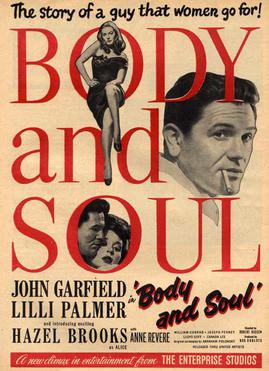
Body and Soul is Robert Rossen's take on the boxing film genre. It begins In medias res with Charley Davis, a rags-to-riches boxing champion visiting acquaintances from his past the night before his title defense fight. The rest of the film then takes place as a flashback Charley has during a nap, up until the fight itself. Rossen's use of these narrative devices help to establish the reflective and regretful tone of the movie. The audience is able to see Davis' journey not only in the typical rise and fall arc of the boxer, but also through the eyes of a protagonist, with every joyful memory a reminder of what is lost, and every mistake or bad decision a step closer to where he currently is.
At it's core, Body and Soul is an economic film. It explores the conflict between market values and economic values, as described by Leger Grindon. With money constantly involved in every interaction and conflict our character has, it is no surprise that in the final boxing match of the film, the opponent is given little mention or importance. The true antagonist of the film, that Davis must contend with and eventually overcome, is greed.
Davis starts off as the poor son of the owners of a candy store. Young and ambitious, he is eager to pursue a career in boxing. Through situation and circumstance, he is unlikely to be very successful pursuing any other career, much to his mother's worry. To begin his career he needs equipment, which he alone was not able to afford. A $10 gift from his father gets the ball rolling for him. In this scene the conflict of economic values vs family values is established. The mother, who will throughout the movie represent "the strength and moral purity of the poor" despises the idea of Charley pursuing a career in boxing(Casty 4). She retorts to his ambition of being a fighter: "Well fight for something, not for money", illustrating her disdain for violence in the name of greed. Meanwhile the father's gift, a cash transaction, a market action, simultaneously signifies his approval, and the triumph of market forces.
Unfortunately for the Davis family, the candy shop is soon after struck by a bomb, killing his father. Living with only his mother, he was forced to set aside his boxing aspirations. But with the candy store gone and the primary breadwinner of the family buried, it was not long before the market demanded that Charley box. With a new girlfriend to impress, two rents to pay and a dependent to support, Charley needed money, and he was too proud to accept charity from a welfare organization. Again the economic vs family values conflict erupts, as his mother shouts "better to buy a gun and shoot yourself", to which he retorts "you need money to buy a gun".
Rossen's exploration of the corrupting influence of money and greed is very relevant to the time period of his films. Rossen was known to have been a member of the communist party before the production of this film, and was even blacklisted for several years due to his communist ties.
His perspective on capitalism, and the corrupting influence of money, doubtlessly colored his portrayal of such charming characters as Alice, the gold-digging, promiscuous seductress. When conversing with a former lover, she remarks: "I don't care where his heart is,only the money".
And the cold, emotionless gangster-promoter, who let a fight be arranged with the knowledge that one of the boxers had a blood clot, which could be fatal if he was hit too hard.
In the end, Charley does reject the greed, and refuses to throw the fight. Hanging in the balance was his family, his future with Peg, and the respect of his neighborhood. As Singer puts it: "Ultimately, it is the reminders of family and of his origins that turn him around". The use of flashback hammers home to th audience Davis' sense of regret and loss, and allows what would have appeared to have been a last minute change of heart, to be a final act of defiance in a life led astray. Charley is able to defy greed by winning the fight, to defy the market by choosing to hold onto the things money cannot buy,to defy the gangster-promoter turning his favorite phrase "Everybody dies" back on him, to reject the seductress, and return triumphantly home.